From generative AI tools like ChatGPT to predictive algorithms powering diagnostics, AI is no stranger to healthcare. But a new wave of intelligence is arriving – Agentic AI and it's doing more than just analyzing data or suggesting answers. It's acting on behalf of humans, autonomously managing tasks, adapting to changing conditions, and even initiating multi-step processes with little to no human intervention.
In short, Agentic AI in healthcare is not just a concept. It's already reshaping the way hospitals handle claims, patients book appointments, and health systems scale their operations.
This article breaks down what Agentic AI means, how it differs from other types of automation, where it's driving tangible ROI (especially in Revenue Cycle Management), and what's coming next as major players like UiPath, Thoughtful AI, and Hyro double down on Agentic capabilities.
How Agentic AI Works (vs. Traditional/Generative AI)
Traditional automation, such as RPA, follows predefined rules. Generative AI, such as GPT-based models, generates content and provides answers in response to user prompts. But neither makes decisions nor takes action on its own.
That's where Agentic AI comes in.
An Agentic AI system doesn't just wait for instructions -it takes a goal, decides what steps to follow, and executes them. It can adjust its strategy, access external systems, and even enlist the help of other agents to complete the task. This kind of AI behaves more like a tireless virtual teammate than a passive tool.
In healthcare, this means agents can:
- Log in to payer portals to verify insurance
- File prior authorizations or refile denials
- Manage billing workflows end-to-end
- Schedule appointments based on patient preferences
- Monitor hospital beds and medication inventory, and take appropriate action.
It's autonomy with accountability – most systems still operate within set guardrails, but the speed, resilience, and contextual awareness go far beyond what legacy bots or scripts can do.
Unlike traditional AI, which offers insights or predictions, Agentic AI behaves more like an independent problem solver. It can make decisions, execute multi-step tasks, and adapt based on feedback – all without needing a person to micromanage each step. In other words, an Agentic AI in healthcare is like an intelligent assistant that prioritizes actions and handles tasks (e.g., scheduling follow-ups or coordinating care) much as a diligent human staffer would, but at digital speed.
To clarify the jargon, it helps to contrast Agentic AI with other AI types:
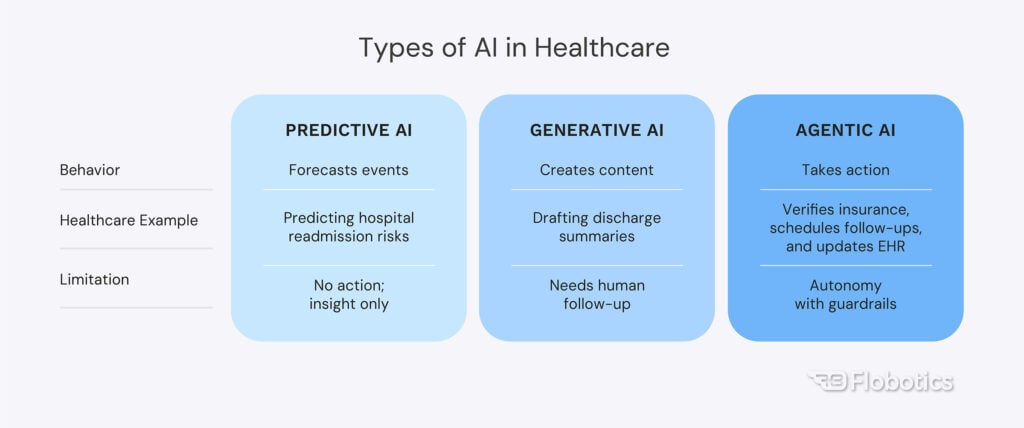
- analyzes data to forecast events ("What might happen?").
- (think ChatGPT) creates new content or suggestions in response to prompts, but it remains reactive, waiting for human instructions.
, by contrast, acts proactively. It leverages techniques such as Large Language Models (LLMs), Machine Learning, and automation to carry out tasks and achieve goals with minimal supervision. In short, generative AI creates, while Agentic AI acts. This means that Agentic AI might not wait for a specific prompt every time; once given an objective, it can figure out the steps and execute them, adjusting as conditions change.
Why Agentic AI in Healthcare Is Gaining Traction?
Several converging trends explain why now is the time for Agentic AI in healthcare. First, the industry is grappling with unprecedented administrative burdens and workforce challenges. Healthcare providers spend a considerable amount of time and money on paperwork, billing, and coordination tasks that don't directly improve patient outcomes. In the U.S. alone, an estimated $60 billion was spent on administrative tasks in 2022 – a jump of $18 billion from the prior year. These tasks (like insurance eligibility checks, prior authorizations, claims processing, etc.) are necessary but labor-intensive. They also contribute to high error rates – claim denial rates can reach up to 20%, resulting in billions of dollars in lost revenue. The situation has been worsened by staff shortages and burnout, which drive up costs and slow down operations.
Agentic AI in healthcare directly addresses these pain points by automating high-volume, routine processes in a more intelligent manner than earlier technologies.
Crucially, Agentic AI arrives at a time when AI technology itself has matured. The boom in generative AI has familiarized healthcare leaders with AI's potential (everyone saw what GPT-style models could do with text, images, and even medical knowledge). Agentic AI builds on that foundation: it uses advanced AI models under the hood, but ties them to actionable automation. For instance, a generative AI might draft a response to a patient query; the AI agent will that response, schedule a follow-up appointment based on the content, update the patient's record, and alert the care team if needed – all autonomously. Early examples of Agentic AI, such as autonomous chat assistants and scheduling bots, have demonstrated productivity boosts by automating end-to-end routine tasks. With Machine Learning and NLP now more reliable, and APIs enabling integration with hospital systems, the feasibility of deploying Agentic AI at scale is significantly higher in 2025 than it was even a couple of years ago.
Finally, the economic pressure on healthcare systems can't be ignored. Automation is viewed as a key strategy for achieving more with less. Executives (CTOs, CFOs, etc.) are eyeing Agentic AI as a way to the workforce – essentially a digital labor force that can work 24/7, eliminate backlog, and reduce errors. A McKinsey analysis famously estimated that about 45% of work activities could be automated with current technology. Healthcare, with its mix of data-heavy and rules-based tasks, is ripe for this. In a nutshell, Agentic AI in healthcare provides timely relief, addressing cost and efficiency challenges while leveraging recent AI advancements. It aligns with the urgent need to improve operational resilience in an industry that's both highly complex and highly regulated.

Let’s talk!
In just 15 minutes, we’ll cut through the noise and see if automation works for you.
How Agentic AI Transforms Healthcare – Use Cases
Revenue Cycle Management (RCM): Automating the Full Payment Lifecycle
Agentic AI is redefining how providers manage the most critical operational function: getting paid. It automates nearly every component of the revenue cycle, including:
- Eligibility verification
- Prior authorizations
- Claims submission and tracking
- Denial management
- Payment posting and reconciliation
Unlike traditional bots, Agentic AI understands workflow context, learns payer rules, and can autonomously correct and refile claims, leading to faster reimbursements, fewer denials, and leaner staffing.
Case Study – Flobotics for Claims Automation
A U.S. clinic partnered with Flobotics to automate claims processing end-to-end.
Results:
- 449% ROI within months
- Claims processed 10× faster
- The rejection rate decreased significantly.
Ready to automate your business processes?
Karl – our CTO loves to discuss the ROI. Feel free to book a call with him.
In just 15 minutes, we’ll help you assess whether automation is right for you.


.png)