98% Reduction in Manual Claim Prep | Claims Management Automation
See how an automated EHR-to-claim data pipeline removed up to 250 hours per week of manual RCM work.

About Gentem Health
Gentem Health (now part of a SimplePractice) is a Silicon Valley–based company focused on healthcare providers reimbursement and patient’s financial experience.
Their ambition is to deliver highly innovative, near real-time eligibility insights and upfront reimbursement estimates, giving providers and patients financial clarity before care is delivered.
Before contacting us, Gentem Health relied on manual extraction and transfer of data from various EHRs of various practices into their internal database.
This meant frequent system hopping across EHRs to pull the necessary fields, re-enter information, and correct formatting issues by hand.
Their revenue cycle depends on accurate and consistent data flowing from multiple EHR systems into their billing platform. They also provide medical billing processing service on behalf of its clients.
Challenge | Manual Claim Preparation
Gentem’s billing team was spending up to ~250 hours per week just extracting and correcting EHR data.
The work was slow, costly, and susceptible to many RCM errors like:
- technical denials,
- rework loops,
- delayed claim submission,
- ultimately increased aging in accounts receivable.
On top of that, the workload was scaling faster than the team could handle.
As volume increased, manual preparation became the gating factor for throughput.
Claims that were clinically complete often sat idle in pre-submission queues, waiting on administrative cleanup before they could even enter the claim engine.
Gentem needed a way to remove manual pre-submission steps without changing EHR systems, retraining staff, or disrupting downstream billing workflows.
The core issue was not payer adjudication speed, but lost time before submission.
Once a claim missed its intended submission window, its probability of timely reimbursement dropped sharply - regardless of payer performance.
Claims delayed at the document and data-prep stage were far more likely to enter the revenue cycle late, increasing exposure to aging, rework, and write-offs downstream.
Gentem’s challenge was therefore to stabilize and compress the document-to-claim-ready window - before claims ever entered the payer system.
In short:
Claims management automation was inevitable.
Solution | Claims Management Automation
We approached this project by treating the EHR as the source of truth.
Our agentic AI based integrations were operating between multiple EHRs and Gentem’s databases.
It took relevant data (patients, providers and their location, appointments, services, payments) from the EHRs and inserted it into Gentem’s database so they could process insurance claims based on the information provided.
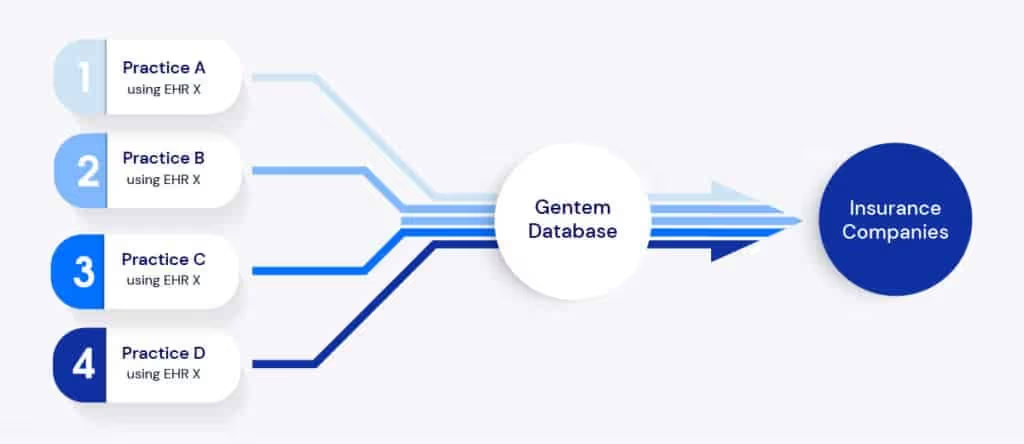
The new system syncs the data from multiple practices using multiple EHRs daily.
Our automation provides the extraction of patient demographics, billing information, provider credentials, appointment details, service line structure, and payment data from each connected EHR.
On top of that, claims management automation targets one of the most critical RCM metrics: clean claim rate.
In this case, “clean claims” did not mean payer leniency or better contracts – it meant eliminating avoidable, human-made errors before submission.
Manual data extraction introduced small but costly mistakes: mismatched patient demographics, missing modifiers, incorrect provider identifiers, or formatting inconsistencies.
Each of these errors could trigger a denial for purely administrative reasons, even when the clinical service itself was fully reimbursable.
Improving clean claim rate therefore meant reducing “stupid denials” – denials caused not by medical necessity or coverage rules, but by preventable input errors at the preparation stage.
By standardizing and automating claim-ready data before submission, Gentem reduced the noise in the denial pipeline and protected revenue that was previously lost for non-clinical reasons.
By improving the consistency of upstream data, Gentem could reduce the rate of technical denials, decrease back-and-forth document requests, limit claim revision cycles, and shorten the time from encounter to claim submission.
Cleaner data also reduces the burden on RCM teams, who often spend a disproportionate amount of time correcting avoidable errors created by workflow fragmentation across EHRs, payer portals, and billing systems.
Results
The impact can be summarized conservatively:
Clean Claim Rate (CRR) increased from ~80% to ~95%.
The improvement reflects reduction in technical denials driven by incomplete or inconsistent upstream data. Cleaner submissions reduced downstream claim touches, stabilizing claims after submission rather than just at intake.
In short:
Strong upstream automation paid off.
On top of that, preparation time for claim-ready data decreased from ~30 minutes to ~2 minutes, and manual effort equivalent to ~6 FTEs was redirected toward higher-value tasks.
Technical denials caused by incomplete or inconsistent data dropped by roughly 30%, contributing to a more predictable reimbursement timeline.
Here’s a short metrics summary:
Summary
While Days in A/R and long-tail collections are measured after submission, their root causes often originate much earlier.
Gentem’s case demonstrates how an agentic AI automation layer strengthens the entire claims lifecycle without adding headcount or forcing changes to existing EHRs.
If your teams are slowed down by manual EHR-to-claim data work or are struggling with clean claim performance, automation of this kind can materially improve accuracy, throughput, and financial reliability–starting at the part of the workflow where claims succeed or fail.
This project proves that you don't need to replace your portals to fix your workflow–you just need an Agent to manage them.

Let’s talk. In just 15 minutes, we’ll cut through the noise and see if automation works for you.