The RCM market is projected to grow significantly, reaching $350 billion by 2034 from its current $135 billion. Therefore, it is essential to monitor the trends shaping this transformation.
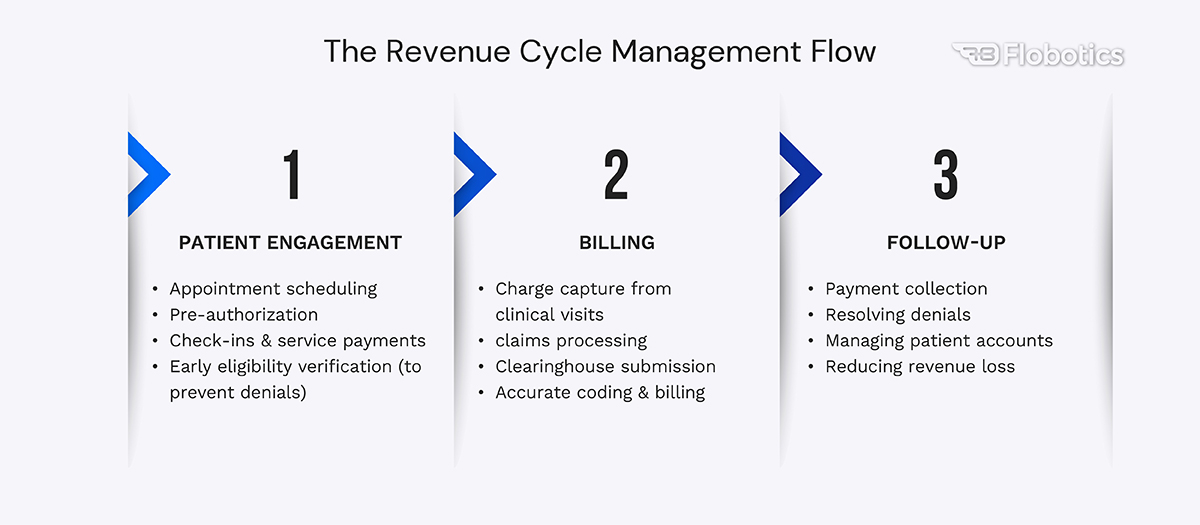
Revenue Cycle Management (RCM) in healthcare ensures that providers get paid for services while maintaining a smooth patient experience. It consists of three key phases:
- Patient Engagement Phase: Covers everything from appointment scheduling and pre-authorization to check-ins and service payments. Ensuring eligibility verification early helps prevent claim denials.
- Billing Phase: Involves capturing charges from clinical visits, processing claims, and submitting them through clearinghouses. Accuracy in coding and billing is essential to avoid reimbursement delays.
- Follow-up Phase: Focuses on managing payments, resolving denied claims, and handling patient accounts receivable. Effective follow-up ensures timely collections and minimizes revenue loss.
With these fundamentals in place, let’s explore the top RCM trends addressing challenges faced by the industry.
1. AI Integration into RCM
Artificial Intelligence (AI) is transforming RCM by addressing some of its most pressing challenges. AI encompasses various tools, including Natural Language Processing (NLP) to analyze unstructured data like patient notes and Generative AI, which automates tasks such as drafting denial letters and generating financial reports.
How AI Improves RCM Processes
Denial Management:
AI predicts denial patterns and suggests preventive actions, reducing the denial rate significantly.
Eligibility and Pre-Authorization:
AI-powered bots streamline insurance verification and pre-authorization workflows.
Patient Communication:
AI chatbots improve engagement, answering billing questions and explaining patient balances in real-time.
Claim Processing:
AI enhances claim accuracy by flagging errors before submission.
Why It Matters: AI minimizes errors, enhances efficiency, and allows staff to focus on high-value activities instead of repetitive tasks.
2. Automation in Pre-Authorization and Eligibility Verification
Late eligibility checks and pre-authorization approvals are among the leading causes of claim denials and patient non-payment. If an insurer denies a claim due to eligibility issues, providers may struggle to recover costs from the patient, who may have already undergone the procedure. Automated eligibility and pre-authorization verification solutions are being widely adopted to combat this. These systems schedule and conduct real-time checks, ensuring patients are financially cleared before services are rendered. By integrating automation, providers can reduce administrative burdens, minimize claim denials, and improve revenue capture.
Solutions:
Robotic Process Automation (RPA):
Automates routine tasks like checking insurance eligibility, extracting patient details, and submitting pre-authorization requests without manual intervention.
Artificial Intelligence (AI) & Machine Learning (ML):
AI-driven tools analyze historical data to predict denials and recommend the best pre-authorization approach, while ML continuously improves accuracy over time.
Natural Language Processing (NLP):
Enables automated extraction of relevant details from unstructured clinical notes and insurance policies, speeding up verification processes.
Electronic Data Interchange (EDI):
Facilitates seamless communication between providers and payers, ensuring real-time eligibility confirmation and reducing approval delays.
Cloud-Based RCM Platforms:
Integrated platforms that centralize eligibility checks, pre-authorization tracking, and real-time payer interactions in a single interface.
Why It Matters: Efficient eligibility verification reduces denials and accelerates revenue capture.
3. Big Data and Predictive Analytics
In 2025, Big Data continues to be a game-changer for RCM. Beyond just numbers, data transforms into actionable intelligence that optimizes financial performance.
Key Benefits of Big Data in RCM:
- Denial Insights: Analytics tools identify patterns in denials, enabling proactive strategies to reduce occurrences.
- Performance Dashboards: Real-time dashboards track KPIs such as denial rates, collection timelines, and patient payment behaviors.
- Revenue Optimization: Predictive models forecast cash flow and patient payment probabilities.
How to Stay Ahead:
- Implement real-time analytics to monitor metrics like accounts receivable (AR) days.
- Use data visualizations to pinpoint bottlenecks and improve collection efforts.
Why It Matters: Big Data empowers healthcare providers to make informed decisions, reducing inefficiencies and maximizing revenue capture.
4. Automation to Address Staffing Shortages
Staffing shortages remain a significant pain point in healthcare, leading to delays in claim processing and billing. Automation solutions, including Robotic Process Automation (RPA) and AI, are filling the gap by handling repetitive, time-intensive tasks.
How Automation Helps:
- Automates claim submissions, reducing manual workload.
- Accelerates payment posting and reconciliation processes.
- Ensures accuracy in eligibility checks and pre-authorizations.
Why It Matters: Automation alleviates the burden on staff, ensuring that essential RCM processes run smoothly even amid workforce challenges.
5. Interoperability between EHR and other systems
Interoperability is becoming a crucial trend in Revenue Cycle Management, with seamless EHR integration playing a key role in streamlining financial and administrative workflows. More healthcare organizations are adopting automation-driven solutions that effortlessly connect EHRs with RCM systems, ensuring real-time data exchange across billing, claims processing, and revenue optimization platforms.
Here’s the example of automating patient profile creation and appointment scheduling in SimplePractice EHR software:
Sorry, your browser doesn't support embedded videos.
Key Advantages of EHR Integration with RCM Systems:
- Seamless Financial and Clinical Data Exchange: Eliminates data silos, ensuring billing and clinical records remain synchronized.
- Automated Claim Processing: Reduces errors and speeds up reimbursement by pulling accurate data directly from EHRs.
- Enhanced Compliance and Reporting: Ensures adherence to healthcare regulations like the 21st Century Cures Act while simplifying audits and reporting.
Why It Matters: By integrating EHRs with RCM systems, healthcare providers can enhance workflow efficiency, reduce revenue leakage, and improve overall financial performance—all while delivering a better patient experience.
6. Focus on Denial Management
Denials are one of the most significant pain points in RCM. In 2025, providers are doubling down on denial management strategies, leveraging technology and process optimization to minimize revenue leakage.
Denial Management Strategies:
- Use AI to predict and prevent denials by analyzing historical data.
- Implement real-time monitoring systems to flag potential issues before submission.
- Train staff to recognize and resolve common causes of denial.
Why It Matters: Addressing denials proactively can recover millions in lost revenue and improve cash flow.
7. Mobile-First Patient Financial Engagement
Patients increasingly expect digital-first interactions and mobile-first billing and payment solutions are becoming a priority for RCM strategies.
- Mobile Billing & Payments: Patients prefer mobile-friendly statements and payment portals.
- Text & App-Based Reminders: Automated notifications improve on-time payments.
- Flexible Payment Plans: Mobile-friendly financing options reduce outstanding balances.
Why It Matters: Mobile-first strategies enhance patient satisfaction and increase collection rates.
8. Outsourcing for Cost Efficiency
Outsourcing RCM functions is gaining traction as hospitals face financial strain and workforce shortages. Companies specializing in RCM outsourcing are offering expertise and scalability.
Benefits of Outsourcing:
- Reduces operational costs by leveraging external teams.
- Provides access to advanced tools and processes without significant capital investments.
- Frees internal resources to focus on patient care.
Why It Matters: Outsourcing offers a cost-effective way to maintain efficiency and compliance in a challenging financial environment.
9. Patient-Centric Payment Options
Patients increasingly expect consumer-friendly payment solutions, including online portals and flexible payment plans. RCM strategies are adapting to meet these demands.
What’s Changing:
- More providers are offering online billing portals for easy payment access.
- Flexible payment plans are becoming the norm for high-deductible healthcare costs.
Why It Matters: Enhancing the patient payment experience improves satisfaction and collections.
10. Real-Time Revenue Intelligence
Healthcare providers are adopting real-time revenue intelligence tools to make immediate financial decisions and optimize revenue cycle performance.
How Real-Time Intelligence Improves RCM:
- Instant Insights: Live dashboards track claim status, denials, and revenue trends.
- Dynamic Decision-Making: AI-driven analytics help predict and resolve issues before they impact cash flow.
- Operational Agility: Provides real-time adjustments to workflows based on revenue fluctuations.
Why It Matters: Real-time revenue intelligence allows providers to maximize revenue potential and reduce inefficiencies.
11. Cybersecurity with Blockchain Technology
With cybersecurity threats rising, blockchain technology is emerging as a reliable solution for securing sensitive RCM data.
How Blockchain Enhances Cybersecurity:
- Data Integrity: Blockchain’s decentralized ledger ensures that patient and financial data cannot be altered without detection.
- Access Control: Smart contracts provide granular control over who can access specific data, ensuring compliance with HIPAA and other regulations.
- Fraud Prevention: Blockchain prevents duplicate or fraudulent claims by maintaining an immutable record of transactions.
Why It Matters: Blockchain offers unparalleled security, safeguarding healthcare organizations against data breaches and ensuring trust in financial processes.
Conclusion
The RCM trends in 2025 are driven by a need to address the industry’s most significant pain points, including denials, EHR inefficiencies, and workforce challenges. Technologies like AI, Big Data, and blockchain are transforming processes, while outsourcing and patient-centric solutions offer immediate relief for operational bottlenecks. Whether through advanced automation or enhanced interoperability, these trends provide healthcare organizations with the tools to optimize revenue cycle performance and ensure financial stability.
At Flobotics, we specialize in healthcare RCM automation and understand how to implement the right technologies to streamline your processes, reduce denials, and improve overall efficiency. Whether you need AI-driven solutions, RPA implementation, or seamless EHR integration, our team of experts is here to help.
Ready to scale without growing headcount?
Let’s talk!

Let’s talk!
In just 15 minutes, we’ll cut through the noise and see if automation works for you.
Ready to automate your business processes?
Karl – our CTO loves to discuss the ROI. Feel free to book a call with him.
In just 15 minutes, we’ll help you assess whether automation is right for you.