The ability of Robotic Process Automation (RPA) to modernize business operations and reduce costs has provided organizations the opportunity to automate unexciting business processes, allowing workers to devote more time to other higher-value work. According to Forrester, the RPA market is expected to grow to $2.9 billion before the end of 2023.
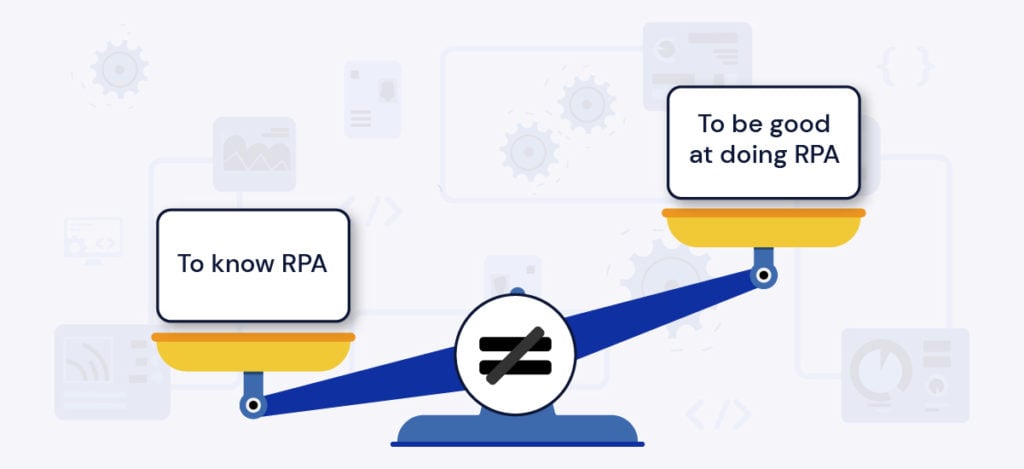
However, designing and developing a good robotics implementation requires a deep level of technicality. While it is true that anyone can learn to code robots, not everyone will be good at it. Read on to find out why as a technical RPA developer, I’ve come to such a conclusion.
The Technicalities Of RPA
In my undergraduate days, Courses like Unix Fundamentals, Programming, Calculus I, II, III, Discrete Mathematics I, II, Electronic Principles, etc., were part of my curriculum for my Bachelor’s degree in Computer science, which gave me a perfect head start and contributed to my success in the RPA world. Don’t get me wrong, I’m not saying that a Computer Science degree is necessary to be efficient at RPA, but technical people will do much better than people in Arts & Humanities.
A non-technical person can be a good developer; pretty much everything can be taught today, but the journey would be much more vigorous in such an instance. The following are the things that were foreign to me when I started:
- Object-Oriented vs. Scripting Languages
- Object-Oriented Concepts
- Regex
- Differences between static and non-static
- Algorithm optimization
- Scalability
- Reusability
- Clean code
- d{1,2}/d{1,2}/d{2,4}
Let’s take two people, for example, one technical and the non-technical. Finding the differences between the automation of two Excel files will yield two very different solutions for both of them.

So, a non-technical person will probably find no need to think about things like scalability and reusable components involved. And what happens in a situation where we decide to go a lot further by adding more Excel files, increasing the rows to thousands, and instructing them to run the program hundreds of times a month? A solution that wasn’t scalable past two small Excel files won’t be good. And this is where experience comes in! So, the ability to see the bigger picture and foresee the possible future of automation is essential.

Let’s talk!
In just 15 minutes, we’ll cut through the noise and see if automation works for you.
Knowledge Of RPA Software
The knowledge of the software program is learnable to a certain degree but takes longer. The extent of the digital domination of today’s world has made the automation of varying repetitive tasks and processes prevalent. RPA helps automate these repetitive tasks by identifying and simulating human interactions with legacy systems.
Implementing RPA only requires adding existing processes and legacy systems instead of installing new infrastructure. RPA tools like Blue Prism and UiPath are needed to develop processes. So, it will take much longer to grasp these tools if there isn’t a technical knowledge foundation. As a technical RPA developer, I don’t have to think about things too much compared to a person who doesn’t fully understand the basics.
Learn more about RPA workshops and training on building and deploying RPA bots and infrastructures in a chosen automation tool and following RPA best practices.
General Process Automation And Business Skills Knowledge
Business process automation paves the way for a streamlined workflow unbridled by manual, time-sucking tasks. BPA enables you to automate Analytics, Sales, Planning, and Customer relationships.
If you don’t know all the ins and outs of a process, including who is responsible for operating it, you probably won’t be able to automate it effectively.
Your technical background and experiences would have shaped you and provided more insight into how well processes function. So this creates a clear path for higher productivity and eliminates wasteful activities.
Conclusion
Saying that anyone can develop an RPA code is a big misconception by the public, fuelled by the top RPA software companies claiming that the platform is low-code and anyone can become a citizen developer. Anyone can learn to play chess in a matter of minutes. There are only a handful of moves and rules to remember, but being great at chess is a different story. But even if that person eventually becomes good at coding, it still doesn’t make them a computer scientist.
Hire a technical RPA developer with an excellent understanding of all ins and outs of Robotic Process Automation.
Like the article? Spread the word
Ready to automate your business processes?
Karl – our CTO loves to discuss the ROI. Feel free to book a call with him.
In just 15 minutes, we’ll help you assess whether automation is right for you.