How to Build an Effective Automation Department in Your Company? [+ Infographic]

Regarding Robotic Process Automation (RPA), we firmly believe in its tremendous potential to streamline operations, drive efficiency, and innovate how businesses operate. However, for organizations to optimally harness these benefits, it’s crucial to establish a dedicated framework that systematically leads the implementation and governance of RPA. This is where an Automation Department (also known as a Center of Excellence) comes into play. In the realm of RPA, an Automation Department (AD) is not just another buzzword; it is a strategic investment that offers substantial dividends. Let me take you through what an AD is and why it’s indispensable for companies venturing into RPA.
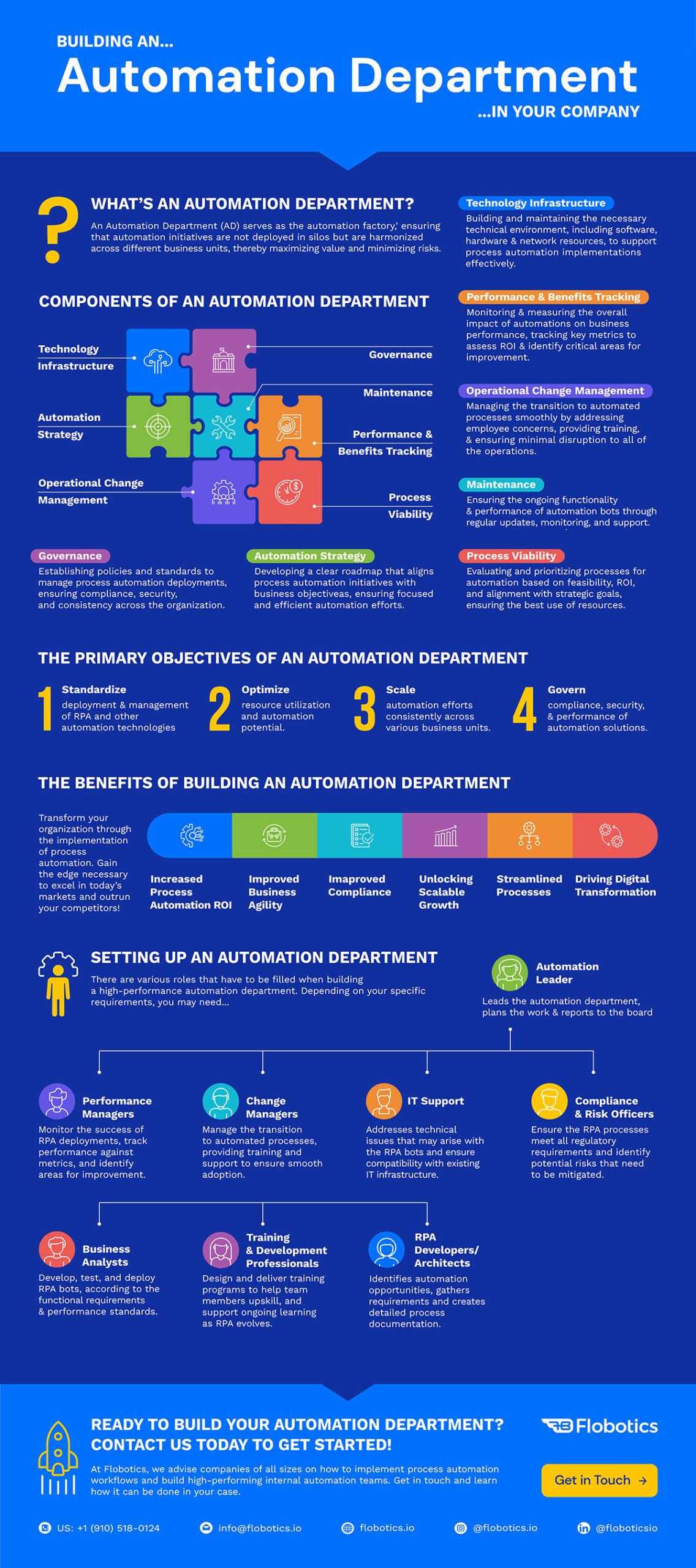
What is an RPA Automation Department?
An Automation Department is a dedicated team consolidating leadership, training, best practices, and support for a specific focus area. Regarding RPA, an Automation Department serves as the “automation factory” for the entire enterprise, ensuring all RPA initiatives align with the company’s strategic goals.
Indeed, an Automation Department functions just like a factory: every department and team comes to the AD with their unique idea, and the AD handles it from conception to execution. This includes idea evaluation, analysis, development, testing, and process automation.
An Automation Department ensures that RPA initiatives are not deployed in silos but are harmonized across different business units, thereby maximizing value and minimizing risks.
Why Do Companies Need an Automation Department?
The importance of an Automation Department cannot be overstated. A structured approach becomes crucial as businesses scale their automation efforts to avoid chaos and inefficiencies. Here’s why an AD is essential:
Strategic Alignment
Ensures that RPA initiatives are aligned with the company’s overall strategy and goals.
Resource Efficiency
Streamlines resource allocation and avoids redundant efforts across departments.
Standardization
Establishes and enforces standards and best practices, leading to consistent quality and performance.
Scalability
Facilitates the scaling of RPA initiatives by creating reusable assets and knowledge.
Governance and Compliance
Maintains control over automation processes to ensure compliance with regulatory and internal policies.
Innovation and Continuous Improvement
Promotes a culture of continuous improvement and innovation by leveraging the latest advancements in RPA technology.
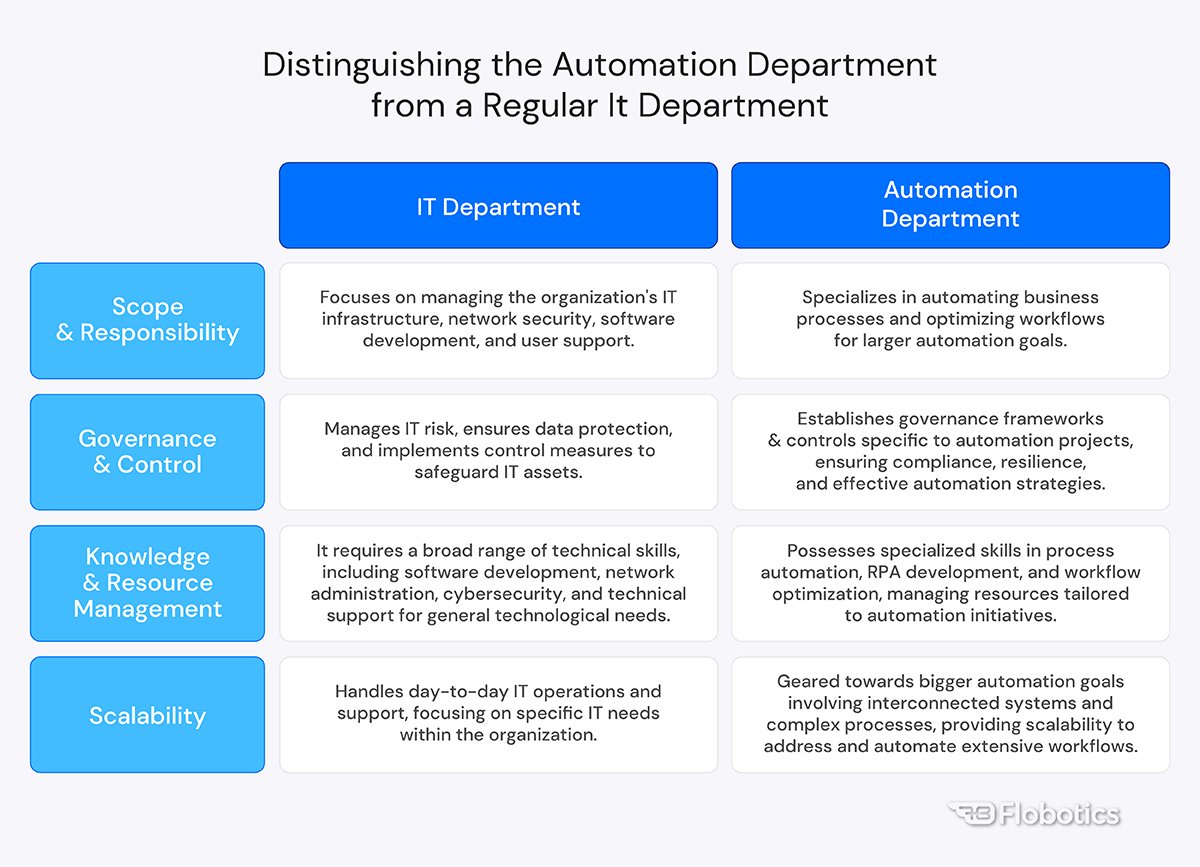
Distinguishing the Automation Department from a regular IT Department
The core difference between an Automation Department and a typical IT Department lies in their structure, function, and scope. A regular IT Department primarily focuses on maintaining and supporting the organization’s IT infrastructure. Its function is mainly technical, and its scope is usually limited to ensuring the smooth operation of IT systems, networks, and user support.
Conversely, an Automation Department is open to more than just the technical aspects of IT. It takes a holistic approach that encompasses strategic planning, governance, change management, and continuous improvement in automation. The Automation Department provides direction, sets standards, manages resources, and drives automation adoption across the organization. This includes identifying automation opportunities, developing and deploying bots, and ensuring the scalability and efficiency of automated processes.

Let’s talk!
In just 15 minutes, we’ll cut through the noise and see if automation works for you.
Steps to Building an Automation Department with RPA
Building an Automation Department is a strategic initiative that can significantly transform business operations by enhancing efficiency, reducing costs, and improving customer experiences. A critical aspect of this process is assembling a skilled team that can effectively automate processes and drive continuous improvement. Below is a comprehensive step-by-step guide to help you establish an Automation Department within your organization.
1. Define Objectives and Vision
Determine which specific processes are currently inefficient, resource-intensive, or prone to errors and would benefit from automation. Establish a clear vision for how automation will address these issues and support the overall business strategy.
2. Assess Current State and Identify Opportunities
Conduct process audits and prioritize processes, ranking processes based on their potential impact, feasibility, and alignment with strategic goals.
3. Establish Governance and Framework
Define roles, responsibilities, and decision-making processes for the automation department. Set standards for automation processes, data security, compliance, and change management.
4. Select the Right Tools and Technologies
Choose the appropriate RPA and AI tools that align with your organization’s needs and technical requirements. Ensure the selected tools can integrate seamlessly with existing systems and technologies.
5. Build a Skilled Team
Recruit or train individuals with the necessary skills to form a competent automation team.
Key roles include:
RPA Developers
They design, construct, and maintain the RPA bots. Their expertise lies in programming, problem-solving, and a comprehensive understanding of RPA tools.
Solution Architects
They design the overall automation architecture and ensure alignment with IT infrastructure.
Business Analysts
These experts analyze existing processes and identify automation opportunities. They bridge the gap between technical and non-technical stakeholders, translating business needs into functional requirements.
Project Managers
These professionals ensure that all automation initiatives align with business objectives, coordinating efforts across teams to meet project goals on time and within budget.
IT Support
These professionals ensure that RPA initiatives harmonize with existing IT systems and infrastructures. They troubleshoot technical issues and safeguard the smooth operation of the RPA bots.
Change Managers
They oversee the transition phase, facilitating communication, training, and adjusting new operational methods.
Compliance and Risk Officers
These professionals ensure the organization’s RPA activities align with regulatory obligations. They proactively identify and mitigate risks associated with RPA.
Performance Managers
They measure the success of RPA implementations against established metrics, identifying areas of improvement.
Business Roles (typically provided by the client):
Sponsor
Typically, the sponsor is a senior executive who provides the necessary resources, removes roadblocks and ensures the alignment of automation initiatives with the organization’s strategic goals.
Business Representatives
These individuals represent the end-users and business units, providing insights into the processes to be automated and validating that the solutions meet business needs.
6. Develop and Implement Pilot Projects
Begin with pilot projects to demonstrate value and build confidence in automation solutions. Use feedback from pilot projects to refine processes and improve the implementation approach.
7. Scale Automation Efforts
Develop a detailed roadmap for scaling automation across the organization, including timelines, milestones, and resource allocation. Gradually increase the scope of automation to include more complex and critical processes.
8. Monitor and Measure Performance
Monitor key performance indicators (KPIs) such as ROI, cost savings, process efficiency, and employee satisfaction. Regularly review and optimize automated processes to ensure they continue to deliver value.
9. Maintain and Support
Establish a support structure to address issues, maintain automated processes, and ensure they remain up-to-date. Stay agile and adapt to new technologies and changing business needs to keep the automation strategy relevant.
An Automation Department in Action
An Automation Department can be created internally, hired externally, or outsourced. Here is an example of how we provided our automation department services to Pain Treatment Centers of America (PTCoA):
PTCoA approached us with the mission of automating their insurance claims submission process. Within two weeks, we developed a bot that processed insurance claims automatically, reducing execution time to just 45 seconds. This MVP project achieved a 100% ROI in 23 days, projecting $180,000 in savings for the first year.
Sorry, your browser doesn't support embedded videos.
This success led PTCoA to create a rich backlog of automation ideas across various departments. As their outsourced automation department, we developed a comprehensive suite of bots tailored to their needs, significantly improving PTCoA’s operational efficiency. Our automation solutions enabled PTCoA to streamline various processes, reduce manual effort, and enhance its focus on patient care and strategic growth.
Based on the projects’ overall costs (including two RPA developers and licenses) and the financial value delivered, the ROI for year one is predicted to be 449%, with total savings exceeding $400,000.
The work is ongoing. We are still adding new processes to the backlog, validating their automation potential, and planning new bots to add to the network. PTCoA is set to scale, with happier employees, satisfied customers, and a strongly improved bottom line.
Outsourcing your RPA development offers several advantages: faster deployment, immediate cost savings, and access to specialized expertise. Companies like PTCoA can focus on core operations while leveraging scalable, cost-efficient automation solutions that deliver high ROI quickly. Outsourcing also provides the flexibility to adapt resources based on project needs, all without the overhead of building and maintaining an internal team.
Conclusion
An Automation Department differs from a regular IT team through its comprehensive ‘factory’ model. The Department oversees the entire automation process—from the initial idea to full implementation—by standardizing processes, ensuring governance, and fostering innovative automated solutions.
The Automation Department offers significant benefits, such as ensuring all automation initiatives align with the organization’s larger goals, establishing and maintaining standard processes, promoting inter-departmental communication and collaboration, and managing resources for maximum ROI. Establishing an Automation Department is the way to optimize your automation efforts and achieve sustainable success. At Flobotics, we’re dedicated to supporting you in building an Automation Department that delivers lasting value and aligns with your strategic goals. For further guidance or support, feel free to reach out to our team of experts.
Like the article? Spread the word
Ready to automate your business processes?
Karl – our CTO loves to discuss the ROI. Feel free to book a call with him.
In just 15 minutes, we’ll help you assess whether automation is right for you.


![Automation’s for Everyone: 100 Real-World RPA Use Cases Across Industries [2024 Updated]](https://cdn.prod.website-files.com/6953a9bbd8e7404f6a765c34/69737184d952701577a6f548_9743a5b8-b26d-4792-a7dd-0b1af64ce8ae.avif)