AI, Automation, and the Rise of Digital Workforces in the U.S. Healthcare
Intro | 2025 as a Breaking Point
2025 was one of the most demanding years for healthcare finance.
Rising denial rates, manual admin work, and shrinking margins dominate in last year's reports – from Deloitte to HFMA.
The RCM market itself is projected to grow from ~$135B today to over $350B by 2034. It is a clear signal that financial operations in healthcare are becoming as critical as clinical delivery
Unfortunetly, the U.S. still burns nearly $1 trillion a year on administrative overhead. Even top performers struggled to keep Cost-to-Collect under 4%.
RCM teams faced staffing gaps, delayed reimbursements, and outdated tech that slowed more than it helped, while patients demanded transparency, speed, and digital-first billing.
Amid tightening AI governance and compliance, automation and agentic AI became the only viable path to efficiency and ROI.
With CMS introducing the WISeR Model in 2026 to drive AI-enabled prior authorizations and cut low-value services, the need for true RCM transformation has never been clearer.
Before You Read
- Agentic AI in RCM – an automation capable of executing multi-step workflows (e.g., eligibility checks, triggering appeals, and reconcile payments) using data from multiple systems via APIs.
- FHIR – Fast Healthcare Interoperability Resources is the backbone of modern interoperability. It allows healthcare systems to exchange data across systems in real time – a major enabler of "no-touch" RCM workflows.
- VBC (Value-Based Care) – A reimbursement model that ties provider payments to outcomes, efficiency, and patient satisfaction, not just service volume. For RCM teams, VBC requires integrated analytics, accurate coding, and automation to ensure compliance and timely reimbursement.
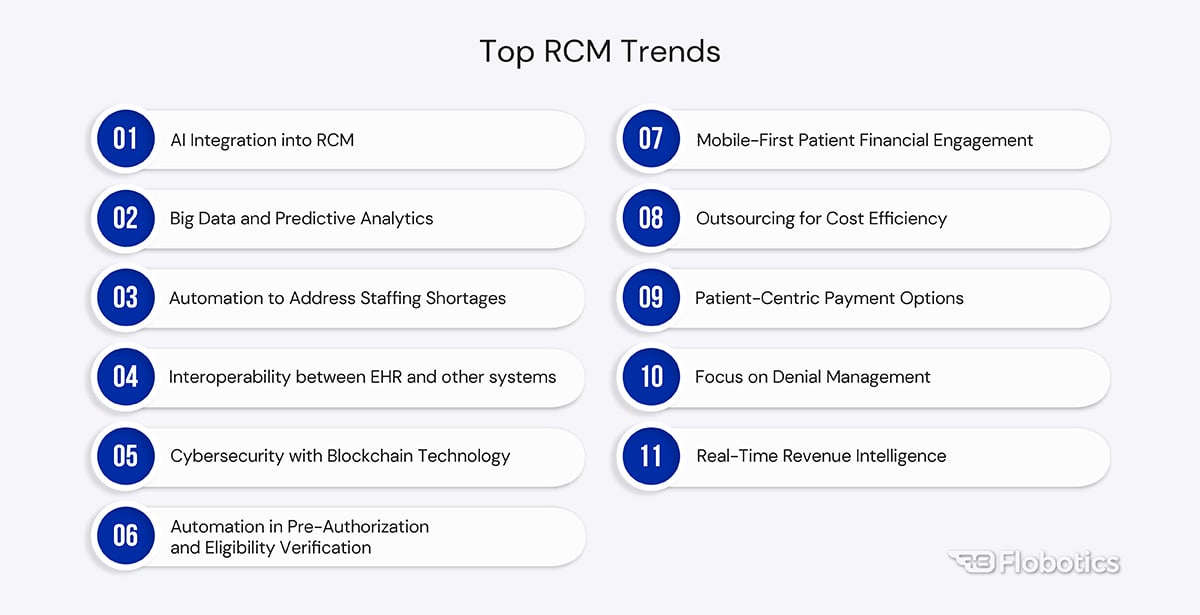
Top RCM Trends in U.S. Healthcare | 2026 Edition
Agentic AI Rules!
AI is no longer a side project or a test case in RCM.
Analysts estimate nearly $1 trillion in U.S. administrative spend remains automatable. Deloitte's 2025 Global Health Care Outlook explicitly calls this out.
Referrals, scheduling, data entry – these processes are prime targets for intelligent automation and AI.
Early adopters report 3–5-point reductions in Cost-to-Collect, 30–50 percent faster cycle times, and payback periods measured in months.
According to MedCity, over 90% of revenue cycle leaders are already prioritizing AI for business segments like collections, payer communication, and patient financial services.
Budgets move only when automation can keep Cost-to-Collect below 3–4% of net revenue, cut denial rates, and shorten AR days.
This means digital transformation is an operational necessity rather than an innovation project.
Moreover, the digital workforce is already handling entire workflows that once demanded full teams. Agentic AI saves FTEs, cuts CTC, and allows the RCM team to focus on unique cases.
Quantitative benchmarks are also shaping how executives evaluate automation success.
The latest CAQH and AHA reports show that automating eligibility verification alone can deliver 77% savings per transaction, reducing national administrative waste from $83 billion to $65 billion.
Metrics like these now serve as the financial foundation for automation ROI discussions at the board level. In practice, this means:
- AI predicting denials before submission
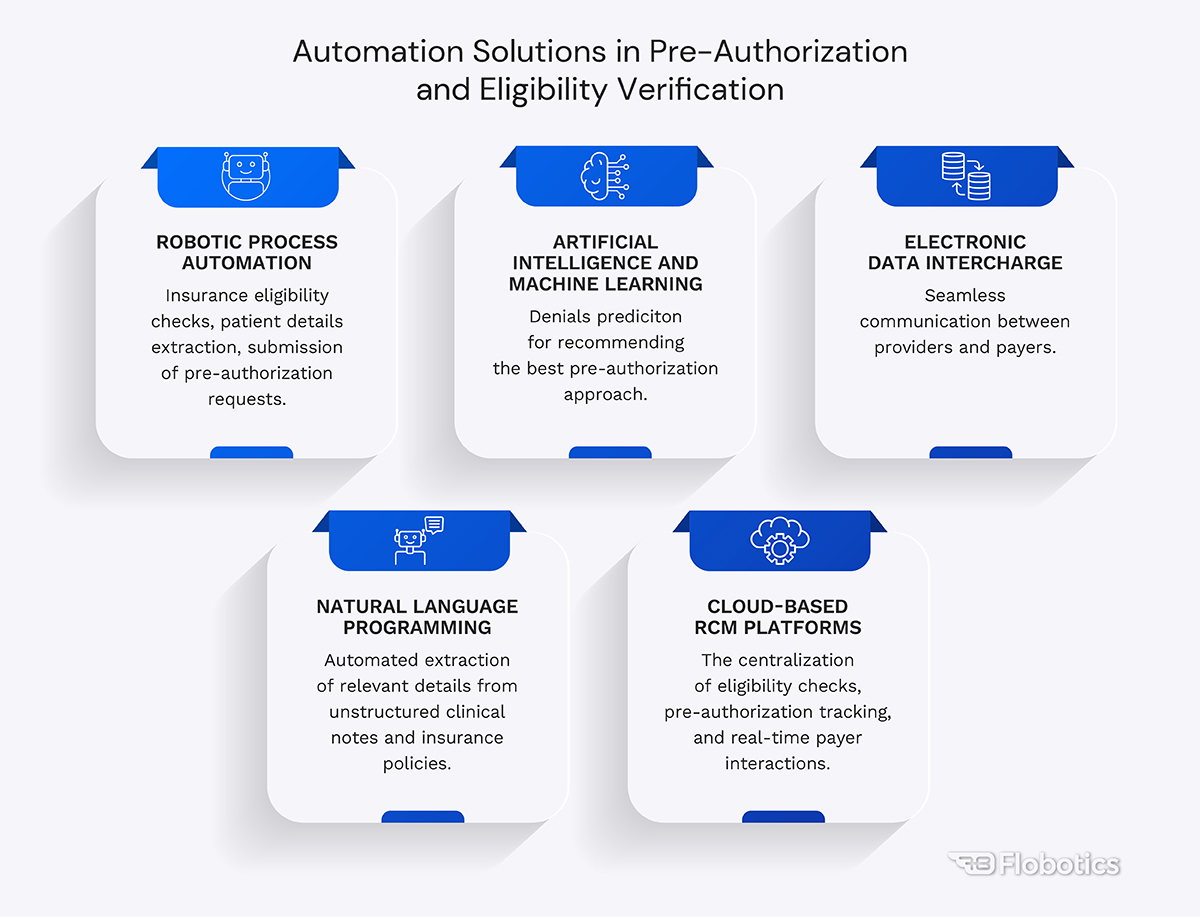
- Bots handling eligibility and pre-auth in real time
- Automated claim scrubbing before clearinghouse submission
- Patient-facing AI explaining balances and payment options instantly
If you'd like to learn more about specific RCM automation case: Click here to read PTCoA case study.
Multiple industry reports also call this trend a "hyperautomation shift".
In short:
Eligibility verification, claim submission, denial management, resubmission, payment posting – it's all going to be automated in the nearest future.
Consumerization is Key
Patient experience has officially moved from a "soft metric" to a core financial driver in RCM.
2025 trend reports all point in the same direction:
- billing transparency,
- self-service,
- consumer-grade design
These are now priorities for healthcare finance teams.
With value-based care and NPS-style metrics gaining traction, satisfaction at financial touchpoints–clear estimates, real-time coverage checks, and fewer billing surprises–now feeds directly into contract performance, reimbursement rates, and long-term revenue growth.
This shift is powered by technology.
Cloud-based RCM platforms with open APIs have become the new standard, enabling real-time data exchange between payers, providers, and patients.
Reports from Definitive Healthcare and HelixBeat highlight FHIR and payer API integration as key 2025 milestones–allowing instant claim visibility, faster status updates, and proactive issue resolution.
Modern systems are expected to deliver automation-ready analytics and compliance by default, not as add-ons.
The result? Patient financial experience is no longer a CX talking point–it's an operational KPI.
Transparency, speed, and usability now define what "best-in-class RCM" means.
No-touch eligibility and pre-authorization remove guesswork at the front desk, while automated, patient-friendly payment plans and reminders drive both collections and satisfaction.
In short:
Patients now expect billing to work like any other digital experience–fast, simple, and transparent. Providers that deliver that will win both loyalty and margin.
Digital Workforce Delivers
2025 has made one thing clear – the labor problem isn't going away.
Late eligibility checks and delayed pre-authorizations remain one of the top drivers of denials and patient non-payment - which is why real-time, automated verification is becoming a baseline capability rather than a differentiator.
Workforce shortages, burnout, and a stagnant labor supply continue to dominate headlines from Deloitte and the Financial Times.
Across healthcare operations, automation and robotics are stepping in to take over the "busy work," giving clinical and RCM teams space to focus on tasks that actually move the needle.
In revenue cycle management, the struggle remains real: denials are rising, payment cycles are slowing, and staffing gaps keep widening.
That's why automation has shifted from a nice-to-have to a stabilizing force – the only lever that keeps teams operational as workloads grow.
Recent case studies prove this shift is already paying off.
Omega Healthcare, among others, reported 30–50% time savings across billing workflows like coding, posting, denial management, and even mailroom processing. Some organizations reclaimed over 15,000 hours per month using AI-powered document handling alone.
In a market where patient volumes climb but hiring can't keep pace, automation is now the only scalable way to expand capacity without adding headcount.
The next generation of "digital FTEs" isn't replacing people – it's protecting them from burnout while keeping operations moving at the speed the industry demands.
Wondering what defined healthcare RCM in 2025 and where it's heading next?
Here's our take on this – after all we focus solely on RCM ;-)
Upcoming RCM Trends | 2030 Perspective
Healthcare revenue cycle management won't slow down – it will scale up.
What began as isolated RPA pilots is now evolving into a connected ecosystem where EHRs, payer systems, and internal platforms communicate seamlessly through agentic workflows.
The direction is clear: end-to-end RCM automation.
By the early 2030s, agentic AI will operate as the default RCM engine.
Frameworks such as Genpact's "Gen AI as interface, Agentic AI as execution engine" will set the standard – conversational fronts, autonomous agents behind the scenes.
Cost-to-Collect (CTC) and related efficiency metrics will become board-level priorities.
Boards and investors will expect CTC to match best-in-class benchmarks; automation projects will be evaluated like capital investments – by NPV, IRR, and time-to-ROI.
Inside RCM teams, capacity will be defined as something like:
Y human FTE + Z digital FTE.
Financial performance and automation maturity will become inseparable – a natural step forward.
Patient financial experience and NPS will remain major competitive levers.
Automation will influence payer negotiations, contract renewals, and retention, as billing experience competes equally with clinical quality for growth.
Automation is also transforming patient affordability – enabling self-pay orchestration, digital statements, and personalized reminders that reduce bad debt and boost satisfaction.
Governance will tighten.
Every AI system touching financial or patient data must be auditable, explainable, and compliant with internal and federal regulations.
Regulatory complexity – from the No Surprises Act to VBC expansion and Medicare PFS changes – is pushing automation toward API-native, rule-driven logic.
EHR Softwares on the rise:
- Epic Systems – The most widely used EHR, known for its robust interoperability and RCM features.
- Cerner (Now Oracle Health) – A leading EHR with strong financial and billing integration capabilities.
- DrChrono – A cloud-based EHR with integrated billing and practice management tools, designed for small and mid-sized practices.
- MEDITECH – A widely adopted EHR, especially among community hospitals, with RCM-friendly features.
- eClinicalWorks – A popular choice among ambulatory care providers, offering integrated billing and claims management.
- PrognoCIS – A flexible EHR solution that offers advanced billing features and telemedicine integration.
- NextGen Healthcare – A preferred solution for specialty practices, focusing on revenue optimization and claims management.
Automation maturity will also become a sales and partnership differentiator.
Interoperability and visibility will define high-performing RCM ecosystems, where AI connects every point of the revenue cycle.
Predictive analytics will forecast denials and optimize payer strategy, while clinical and financial data merge under value-based RCM models – linking care quality, risk, and reimbursement.
That's Floboperspective on what's to come in RCM top trends.
Summary | Which Solutions To Choose?
Agentic AI, consumerization, and hyperautomation – these are the 2025 RCM trends that are here to stay for long.
Payers can cut up to 35% of their operating costs using automation. Moreover providers rely on similar solutions to offset shrinking reimbursement rates and rising labor expenses.
In short, the conversation shifts from whether to automate, to how deeply and how fast it can be done.
And that's a good thing both for the revenue cycle management as for the patients.
Which brings us to the following point:
At Flobotics we focus exclusively on automating what matters most in U.S. healthcare revenue cycle management – no generic bots here.
Click here to schedule a call with us >


.png)
![[REMASTERED] 8 Automation Trends in 2025](https://cdn.prod.website-files.com/6953a9bbd8e7404f6a765c34/697372788dc4c8676e60617b_204df8f0-08e0-477e-8d65-0f67e9edcdce.avif)